Friday, 31 March 2017

Week Ending 31/03/17

Another busy, busy week in Year Three.

We started our week in Maths by learning about Division. Division is one of the four basic operations in Maths. We have already tackled three out of the four: addition, subtraction and multiplication. Division is when we take a number which is going to be divided up. We then take a number which is going to be used to divide our first number by. This is our second number. We then have our answer. So, we find ourselves with the following equation:

First number ÷ Second number = Answer

(÷ is the mathematical symbol for division)

Here is an example:

20 ÷ 4 = 5

Division is a handy skill to have for many occasions. If you have ten apples and are looking to divide them amongst five of your friends, division will come to your aid (the answer is two). If you would like to play a division game with apples, please follow this LINK.

To advance your application of division, please have a look at these TIPS.

In Topic we have been learning about Friction. Friction is the resistance that one surface or object encounters when moving over one another. There are three types of friction:

- Fluid
- Static
- Rolling

Fluid friction is the resistance to an object's motion through liquid and gas. Static friction is the resistance to movement when two non-moving solid objects are in contact. Rolling friction is the force that is resisting the rolling movement of an object (such as a football rolling across a pitch).

With our new knowledge of friction we have been coming up with experiments which we believe can highlight one of the three different types of main friction that we have learnt about. With our experiments we have learnt two very important words which we need to think about as we draw up our plans. One is constant. In an experiment, what we are testing needs to be constant. So, if our experiment is regarding rolling friction and we use a toy car going across wood in test one and grass in test two the toy car needs to remain the same. But what do we call, in our test, the difference between wood and grass? This is called a variable. A variable is used so we can test out our constant in different conditions so that we can see whether our hypothesis is correct.

If you would like to learn more about friction, please see this video below:


In English we have been writing our final draft of our letter to NASA. We have been doing multiple drafts, making sure each time to place our school's address, the address of NASA and the date in the correct place. With each draft we have been improving on our letter, not just the content and syntax but with our handwriting too. We have formulated our reasons to go to the moon carefully (from finding resources to the fact that with new technology more people would be able to watch the landing) as well as reasons for not going to the moon (from safety to the fact that robots land on the moon and do a fine job). We have since made a display with our final drafts which have will be scanned and emailed to NASA on Monday! We can't wait to hear back from them and what they have to say!


Monday, 20 March 2017

Week Ending 17/03/17

Another busy week of learning and hard work in Year Three!

In Topic this week we have been learning more and examining what we already know about gravity. We have discovered that gravity is a force which surrounds not only our planet earth but other planets too. It pushes everything in and is the reason why the earth is spherical. We know now that gravity does not push down but merely towards earth (or other planets). We have learnt that when we are in motion this is counteracting against gravity and that gravity always wins. This is why we have life and why we don't float away into space. Gravity also affects the way how our earth moves around the sun.


If you would like to learn some more about gravity, please see this video below:


We also looked at the early life of Isaac Newton. We discovered that Mr Newton was inspired by the work of Rene Descartes and Galileo Galilei. Mr Newton made only a few friends, but one of those was his teacher Isaac Barrow who helped Mr Newton attend Trinity College in Cambridge. If you would like to learn more about Mr Newton, please follow this LINK. And please follow this LINK if you would like to try an experiment to find the centre of gravity using a common broom!

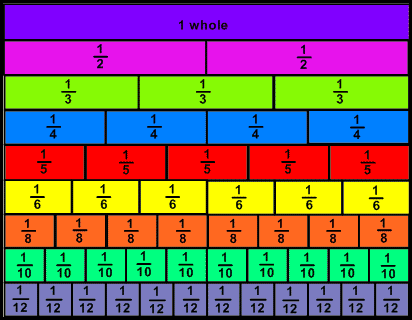
In Maths we have been yet again learning about fractions. We have been learning about mixed fractions. This is when we mix fractions with whole numbers. A whole number is a number without fractions or a decimal part. So, 1 is a whole number as is 2, 3, 4...etc. So, a mixed fraction is when a whole number is followed by a fraction. 7 1/4 is an example of a mixed fraction. We have a whole number (7) followed by a fraction (one quarter, or, one over four).

To understand more fully about equivalent fractions we have drawn our own Fraction Wall!


If you would like to try a game to match fractions, please follow this LINK.

This week in English we have been looking again at letters and have started writing a letter to NASA (National Aeronautics and Space Administration) to ask them either why we shouldn't go back to the moon or why we should.

We have been looking at the first moon landing in July 20th 1969 to get ourselves inspired for our letters:


While there have been numerous unmanned landings since 1976, the last time a manned voyage to the moon was completed on December 19th 1972 when the crew of Apollo 17 returned back to earth. We are curious why this is and that in nearly forty-five years man has not touched foot back on the moon!


We started writing our letter by planning them, writing reasons for and against to go back to the moon. This way we could sketch our ideas down before we started the task of writing a formal letter. We then followed the conventions of a formal letter that we began learning last week. This is done so that we are taken seriously by NASA and that our purpose is both clear and insightful. We are looking forward to reading our finished letters and sending them to NASA with hopes that they will reply!

If you would like to see forthcoming NASA landings and launches, please look at this CALENDAR for dates and times. The website also has an IMAGE of the day.

Friday, 10 March 2017

Week Ending 10/03/17

Even though it has only been four days, our first week back has been a busy one.

In Maths this week we have been learning about fractions. A fraction, quite simply, is a part of a whole which is expressed by two differing numbers.


A fraction is made of two numbers. The numerator is the number above the line of a fraction which indicates how many of the number below the line are taken. The number below the line is called the denominator which represents the whole number.


We have learnt that fractions are nothing to fear and that by writing and thinking of our own examples we have started to tackle equivalent fractions which are fractions that look different but show the same amount.


If you would like to try your hand out at matching some fractions try so with this GAME.

In English we have been looking at what are the features of a formal letter. We have been looking at several different examples but have noticed that regardless of the content contained in the letter when we are writing a letter there are certain things we need to follow. We start our letter by putting our name and home (or if we had our own business) address on the top right-hand corner. We leave a line and then write the date that we are composing the letter. We leave another line and on the left-hand side we write the name and the address of the person whom we are contacting. Before we can then begin the content of our letter we write the word Dear followed by the name of the person who we are writing to always ensuring (because this is a formal letter) to write their surname as well. At the end of the letter we sign off our letter by writing Yours Sincerely followed by a space large enough to sign our name before we then print our name. By signing our name we are showing that we are the legitimate writer of the letter.

In Topic we have started to look at the fascinating world of gravity. Gravity is a natural phenomenon by which mass gravitates to all other mass (mass is another way for saying forms). Gravity influences us everyday to how a pencil can fall off a table to how we can fall off of a bike to how the world is a sphere. We have started to look at the ideas of Isaac Newton. If you want to know more about Mr Newton please have a look at these FACTS. So far, we have only started to look at the broad and fascinating subject of gravity!


Friday morning we celebrated Maslenitsa. We said goodbye to the Winter, hello to the Spring, hello to the sun and hello to the big bear! We had a fun time and enjoyed our blini!


Wednesday, 22 February 2017

Week Ending 22/02/17

Even though it has only been three days, we in Year 3 have been busier than ever on our Topic!

We have been learning this week about the Roman invasion of Britain. When Claudius came to power after the assassination of Caligula he was seen as a weak Emperor due to his limp and slight deafness. He wanted to show his people that he could be strong.  He decided that conquering the land of Britannia (now known as Britain) would be his route to adoration.

In AD43 he sent Aulus Plautius with forty-five thousand Roman soldiers to conquer Britain. Julius Caesar had attempted this one hundred years earlier and had failed. The Ancient Romans believed that Britain was a strange and mythical place surrounded by sea monsters.


When that turned out not to be true, the Romans found something much more strange and deadly: the tribes of Britain!

These tribes included the Silures, the Atrebates and the Catuvellauni. The chieftain of the Catuvellauni's was a man known as Caratacus. Caratacus was a warrior who would not be trampled by the Romans. He led battles and was known for his bravery. He was also, according to the historian Tacitus an eloquent speaker who after his capture and captivity in Rome delivered an eloquent speech to Claudius where he managed to secure his and his families' freedom. Here is his speech:

"If the degree of my nobility and fortune had been matched by moderation in success, I would have come to this City as a friend rather than a captive, nor would you have disdained to receive with a treaty of peace one sprung from brilliant ancestors and commanding a great many nations. But my present lot, disfiguring as it is for me, is magnificent for you. I had horses, men, arms, and wealth: what wonder if I was unwilling to lose them? If you wish to command everyone, does it really follow that everyone should accept your slavery? If I were now being handed over as one who had surrendered immediately, neither my fortune nor your glory would have achieved brilliance. It is also true that in my case any reprisal will be followed by oblivion. On the other hand, if you preserve me safe and sound, I shall be an eternal example of your clemency."


For a full list of tribes, please follow this LINK.

If you would like to play some interactive games about the Welsh Celtic tribes, please follow this LINK.

And if you would like to see a learn more about the invasion of Britain by the Ancient Romans, please see the documentary below:


Mr Ieuan and Mr Chris would like to wish you all a happy holiday and a happy Defenders Day for tomorrow.

Friday, 17 February 2017

Week Ending 17/02/17

The penultimate week of the Winter term and we have been busier than ever!

In Topic this week we have been learning extensively about the Colosseum.


The Colosseum was built by Emperor Vespasian before being finished by his son, the Emperor Titus. The Colosseum was designed to host blood sports and the most popular of these were gladiatorial fights. The Colosseum was built from funds generated by the spoils of war. Slaves taken from far off lands would come to Rome to work on the fields, or the dreaded quarries known colloquially as "The Pit" or as gladiators. But, we were surprised to learn that there were freemen of Rome who would sell their freedom to fight as gladiators (possible reasons for this were to settle gambling debts or for fame).

We have been learning that the floor on which the gladiators fought on was made of wood and covered with sand. Underneath this floor was the hypogeum where animals would come out to be used as sport or to be used against criminals and slaves.


Please see below for a fascinating documentary which shows architects, mathematicians and historians coming together to place into the hypogeum of the Colosseum today a device for lifting up animals to the stage!


In English this week we have been analysing poetry via the work of Kenn Nesbitt (former American children's Poet Laureate). We have been looking extensively at his poem, The Dragon on The Playground


There’s a dragon on the playground

who descended from the skies.
He swooped down on the schoolyard
where he took us by surprise.

He leapt across the blacktop
in a single bounding stride,
erupting flames and lava
to incinerate the slide.

He reared his huge and scaly head
and flapped his leathery wings,
then set the soccer field ablaze
and blackened all the swings.

He cauterised the asphalt
with a sudden, fiery flash.
Then reeled upon the seesaw
and converted it to ash.

He melted all the monkey bars.
The sand was molten glass.
With nothing left to liquefy
he headed for our class.

I doubt we’ll soon be rid of him
despite the fires he’s set.
You see, our teacher likes him,
so he’s now the teacher’s pet.


Through looking at this poem we have been seeing all the ways Mr Nesbitt has tried to paint a picture of an interesting story and how he has achieved this by his writing and craft. We noticed that Mr Nesbitt wrote his poem on an ABAB alternate rhyming scheme. A rhyming scheme is a form of poetry where patterns are formed through the rhyming of key words. If we look at the second stanza of the above poem we can see where Mr Nesbitt used the ABAB rhyming scheme:

He leapt across the blacktop
in a single bounding stride,
erupting flames and lava
to incinerate the slide.

We have discovered one of the reasons that poets choose this way of writing their poems is to make their poems more memorable with a smooth end with words which through their rhyming repetition make the poem catchy. We have also been looking at what makes the poem interesting with Mr Nesbitt's word choices and deciphering their meaning: descended; cauterised; molten are just some words that we have been using our dictionary to understand. If you are looking for a good dictionary online, please follow this LINK for the online version of the Oxford English Dictionary (there are audio files for each and every word so you can hear exactly how they are supposed to sound). This LINK will take you to dictionary.com which has a word of the day...every day! And if you are looking to buy one in print, Mr Chris would highly recommend purchasing the Oxford English Dictionary.

This week in Maths we have stepped up our knowledge and use of angles by finding and accurately measuring angles of a 2D floor plan of a building. We have been taking our time and have tried hard to understand and measure precisely angles which we find constantly in our everyday life.

If you would like to measure some angles for yourself, please see these floor plans below:


Monday, 13 February 2017

Week Ending 10/02/17

This week we have been learning a diversity of skills and knowledge in our three main areas.

In Topic we have begun to learn about Ancient Roman religion. We have been comparing the differences between most modern day religions and the religious beliefs of the Ancient Roman people. Today, the most common religions are monotheistic which means that people believe in one god. The Ancient Romans were polytheistic which means that they believed in many gods. Their gods were also unlike the god of monotheism. Their gods were more like a family friend who (depending on what was needed or wanted) were given gifts and offerings for the desire of the person's prayer. These gods were designated by what they could give people. Some examples are: Neptune the god of the sea and the protector of ships. Minerva the goddess of wisdom and the arts. Vulcan the god of fire and volcanoes.


We have also learnt that like other areas of life, the Ancient Romans took from the Ancient Greeks as you can see from this table below:


If you would like to understand more about the Ancient Roman religion, please see this video:


In Maths we have been learning about angles. An angle is the space between two planes which is measured in the number of degrees it rotates around a central point. We have not only been learning how to measure angles by using a protractor but we have been drawing angles too! We have learnt about the four common types of angle:

A Right angle is an angle which is equal to 90 degrees:


An Acute angle is one that is one that is less than 90 degrees:


An Obtuse angle is one that is bigger than 90 degrees but smaller than 180 degrees:


Reflex angles are angles measuring greater than 180 degrees and less than 360 degrees:


In our quest to discover more about angles and to learn how to find and measure angles of varying degrees we have been designing floor plans for our very own hotels!

In English this week we have been practising our handwriting by copying out the work of the poet Kenn Nesbitt. In particular we have enjoyed his poem Mr. Brown The Circus Clown...

Mr. Brown, the circus clown
puts his clothes on upside down.
He wears his hat upon his toes
and socks and shoes upon his nose.

He ties his ties around his thighs
and wraps his belt around his eyes.
He hangs his earrings from his hips
and stockings from his fingertips.

He puts his glasses on his feet
and shirt and coat around his seat.
And when he's dressed, at last he stands
and walks around upon his hands.

If you would like to hear Kenn Nesbitt read his own poem, please follow this LINK. And if you are looking for some more poems as funny and well written then please have a look at Kenn Nesbitt's wonderful website. There are also some fun games such as MY WORD and TYPING ASTEROIDS II.

Friday, 3 February 2017

Week Ending 03/02/17

This week has been one of change in Year Three but we are working as hard as ever!

This week has been Arts Week. On Monday we were divided into groups amongst Years Two, Three and Four.

With Ms Catrin and Ms Lana we made our own masks.

With Mr Daniel we were given a segmented picture of a teacher's face and from there we had to draw in the other half of our teacher's face.

With Mr Chris we learnt how to make a friendship bracelet. If you too would like to make your own friendship bracelet, please ask us. We've had a lot of practise!

Art week has inspired our classes this week.

In English we have been learning about instructional writing. We have learnt that when we write instructions we are not to presume that our reader knows what we are intending for them to learn. We must assume that our reader has no knowledge of what they are about to do (which in the case of our instructions is that we are informing the reader on how to make a friendship bracelet). We start by telling our reader what they need (the materials they will need to make their own friendship bracelets). We then tell our reader in specific and direct language the measurable steps they need to take to make their project real. We know what the aim is and so we have written down all the steps clearly so the reader can accomplish making a friendship bracelet of their own.

In Maths we have also been learning about estimation by using our mosaic (see below) which we have been making in our Topic classes. We have understood that while we may not know the answer we are taking an educated guess by estimating. So, we saw the size of one tile for our mosaic against the circular wooden board that was to be made on and then estimated how many tiles will be used in total to make our mosaic. When the mosaic is hanging on the wall we will count and see who was right! If you would like to have some go's with estimating, please follow this link:

ESTIMATION GAMES

In Topic we have been making our very own Roman inspired mosaic. We first started by researching mosaics...


We then drew our own mosaic inspired by what we had learnt...


We then worked together as a republic to filter through the best elements of our designs...


We then collectively started to design our class mosaic...


With our design in place we began to make it a reality...


We are very proud of our mosaic and are looking forward to it being hung on the wall! If you would like to see some mosaics for yourself, Mr Chris would highly recommend the Pushkin Fine Arts Museum which has a wonderful collection of Greek and Roman artefacts and art...


This week we have also been practising our team building skills. We did this with two very important sessions. Firstly, we found something to compliment each other and ensured that everyone had a turn...


We then went to the sports hall where we had to move from one island to another using only small items as rafts. Once on our new island we had to make sure that our rafts came to the island with us. No one was allowed to touch the gym floor (the dreaded sea!) and everyone had to get to the island (which we all did!)...


Finally, twice a week on Tuesday and Friday morning we have been learning about art with Mr Chris. We started in the week by looking at different artists and types of art before drawing the same item (a toy rabbit) in different styles of famous artists (from Da Vinci to Warhol). We then looked at the Russian artist Wassily Kandinsky and have attempted some drawings of our own inspired by this artist who worked in the genre of abstract art.

If you would like to see some art by Kandinsky, the Pushkin Fine Art Museum has some of his work on display until 12th February.